Éric Lapointe Canadian, b. 1971
-
 F1 XXL, 2021
 -
Canon de Beauté
-
Enter
-
On the Road
-
Capsule, 2009
-
Famille Nucléaire, 2009
-
Correspon-dance, 2021
-
Correspon-dance Rose, 2021
-
Dany vs. Billy


Bronze is a heavy metal steeped in tradition. An indestructible medium for time travel, its use in contemporary art is now considered non-conformist. Artist Éric Lapointe hijacks this heritage from the past to use sculpture as a way to expose society's flaws, turning it into a sharp tool that puts into perspective what we have become: individualistic, materialistic, possessive, rushed, and obsessive.
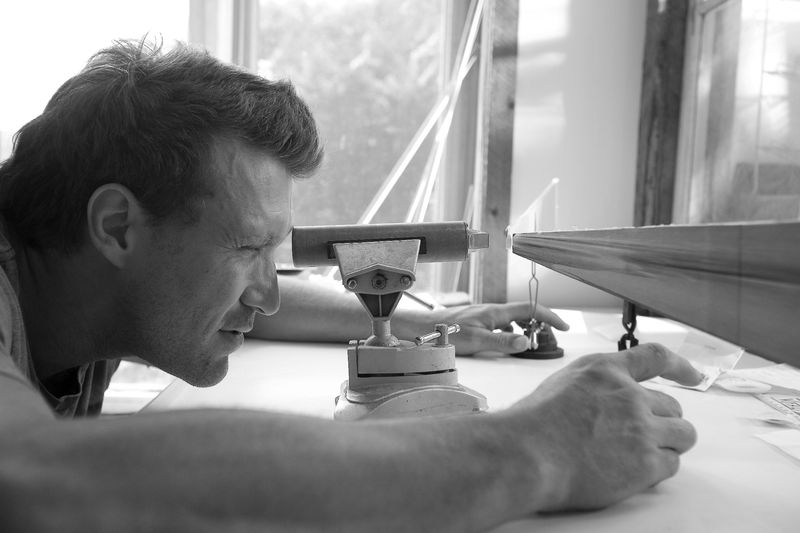
Looking at reality through a different lens, showing the hidden side of ordinary life, opening the mind to a new way of seeing, and developing a critical eye on the world. Lapointe attempts to give perspective to objects, lifting his subjects out of their mundanity to make their hidden reality visible. He seeks to contrast an emancipated and meticulously studied figurative form with a restored image—viewed through a lens integrated into the sculpture—that matches our usual vision of a subject. This optical illusion serves not only the form but also his message, as his goal is to rebel against the self-evident truths that impair our ability to question our habits. Through his choice of subjects, he offers the observer’s critical eye multiple perspectives on the modern world, laying bare the mechanism of appearances and illusion propagated by our society to standardize and uniformize.
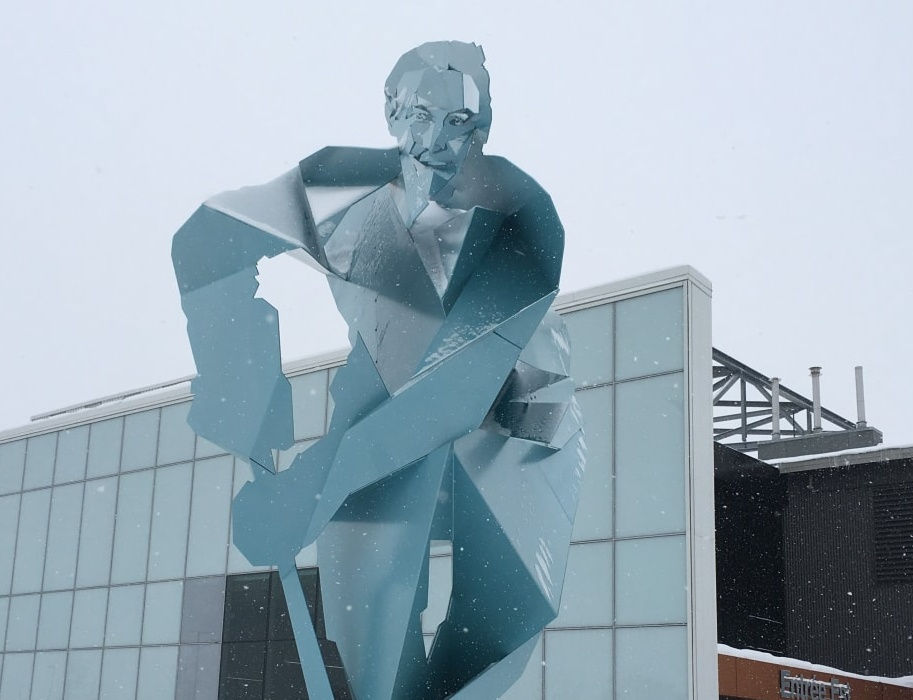
The initial form presented to the observer is difficult to recognize. Curiosity is what leads us to discover the optical system, whether hidden or not, which acts as the key to the enigma. Looking through the lenses, we suddenly gain access to the revelation of the subject in its most banal form. This comfortable vision serves as our landmark and anchor in reality. From there, we better understand the abstraction of the external form, which is restored through a complex play of optical distortions. This principle is called anamorphosis, giving rise to a paradox between reality and illusion. The deformations bursting in all directions correspond to those poorly managed emotions coursing through us. Conversely, the optical restoration seen through the lenses suggests the normality we wish to conform to, the image of ourselves that we cultivate, to the detriment of our intrinsic truth. The convergence of these two divergent realities is found at the narrowest point of the piece, the one closest to the lens. The resulting sculpture thus becomes a sort of inner image, an emotion frozen in time arising from the internal battle we wage with the outside world. Thus, the scientific approach, stemming from the field of optical physics applied to psychic investigation, provides the distance needed for a broader vision.
The lenses, which act as so many filters altering our perception of the world, are left visible to bring to the forefront the importance of understanding, solving enigmas, and lifting the veil on our defense mechanisms. Seeking a balance between the objective and the subjective allows us to dissociate ourselves from mental rigidity and emotional turmoil. It is by temporarily withdrawing from this inner tug-of-war that we can hope to see more clearly, and thus achieve serenity.
Born in Quebec City in 1971 and now living in Grondines, Éric Lapointe earned a Diploma of College Studies (DEC) in Pure and Applied Sciences (1988) at Cégep de Limoilou. He then pursued studies in graphic design (1991) at Cégep de Ste-Foy and finally completed a Bachelor of Visual Arts (2000) at Université Laval in Quebec City. Éric Lapointe has enjoyed a 30-year career as a bronze sculptor. Having previously been represented by galleries in the United States and currently exhibiting in Montreal, his work now enjoys established recognition. Indeed, his sculptures are part of numerous private collections.